Showing posts with label San Francisco peaks. Show all posts

Friday, June 11, 2021

376 miles on two roads from Colorado to Arizona

 Our route today was simple:  US 160 West from Pagosa Springs, Colorado to US 89 South to Flagstaff, Arizona. We started out at 8am with temperatures in the mid-50's and ended the day pushing 90 degrees. 160 West took us past Chimney Rock National Monument between Pagosa Springs and Durango.


An archaeological site that preserves hundreds of ruins from the Ancestral Puebloans who lived here over 1000 years ago, Chimney Rock is in the San Juan National Forest. Not far down the road we passed Mesa Verde, another site where the Ancestral Puebloans lived for over 700 years, building cliff dwellings that exist today. We celebrated as our odometer rolled over to 32,000 miles. 


In Durango, US 160 becomes the San Juan Skyway, twisting 236 miles through the San Juan Mountains of southwestern Colorado. We were only on this route for a few miles, continuing on 160 West while the scenic skyway turns off onto CO 184.


We rode through Cortez, just outside the Ute Mountain Tribal Park. The park is currently closed due to COVID, but we rode past Sleeping Ute Mountain. According to legend, the mountain is the sleeping Great Warrior God who battled evil, was hurt, and lay down falling into a deep sleep.


Until Cortez the scenery was green - irrigated fields of grass and hay and dark green pine trees on the mountain sides. Continuing west past Cortez brown is the dominant color as the desert takes over.


US 160 goes past the Four Corners Monument, the only place where four states meet: Colorado, New Mexico, Arizona and Utah. This is another casualty of COVID, closed by the Navajo Nation to minimize the spread of the disease. We saw several groups of horses today as we rode through the vast  Navajo Nation, and I wondered how they manage to survive on the scarce brown grass. The 2-lane paved highway stretches straight through the desert, only occasionally sweeping in wide turns.


We stopped in Kayenta for lunch at Subway, repeating our lunch stop the first day of our trip almost 2 weeks ago when we rode east on US 160. There aren't many places to stop and eat on the Navajo Nation so we made sure to take advantage of places we know are open. After lunch we continued west on US 160, riding through flat areas that stretched out to hazy cliffs in the far distance that alternated with high rock cliffs and craggy canyons.


We turned south on US 89 with long-distance views of the San Francisco Peaks in Flagstaff, AZ, in front of us.


The temperature climbed and hovered around 90 degrees even as we climbed in elevation to about 7000' in Flagstaff. After 7 hours of travel today, we were ready for an air conditioned hotel room and an early dinner followed by a walk around busy downtown Flagstaff. Tomorrow we head home, finishing our 2-week trip through the Southwest.


Tuesday, September 29, 2020

Riding home from Zion

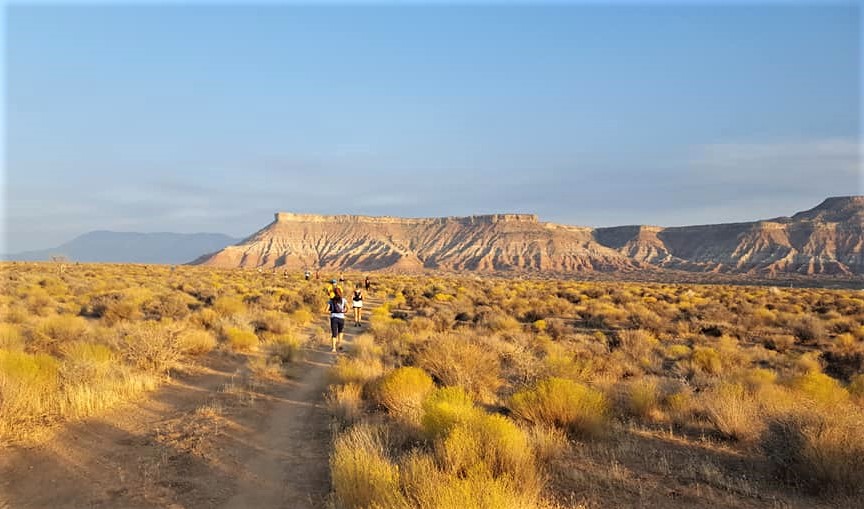
We left La Verkin, Utah about 8:30am local time, heading home after a weekend that included a ride through Zion National Park and a 13.5 mile trail race yesterday.


Riding through the vast southwestern part of the country, where the road stretches before us to the horizon and we can look out over a valley to the mountain ranges 100 miles distant, makes us appreciate the small details. A few cattle grazing in the dry scrub brush, birds lazily swooping on the updrafts, a couple of trees next to an abandoned homestead, the feel of the wind  as we zoom down the almost empty 2-lane paved road.


We rode east on Utah 59, which becomes Arizona 389 and entered the Arizona Strip, the remote, arid, northernmost part of Arizona that lies north of the Grand Canyon. Indigenous people lived in this area for at least 8,000 years and Spanish explorers first saw the South Rim of the Grand Canyon in the 1500's. The first Europeans didn't arrive to this more remote section of present-day Arizona until the late 1700's.

We picked up US 89A in Fredonia and gradually started to climb into the pine forests of the Kaibab Plateau.


We enjoyed the cooler temperatures at this higher elevation as the road curved and climbed to almost 8,000' elevation before we started to wind down into the valley along the Vermillion Cliffs National Monument, known for sherbet-colored swirls of slickrock and towering cliffs.


We crossed over the Colorado River and continued south on US 89 through the Navajo Reservation until we started to see the San Francisco Peaks, a mountain range just outside Flagstaff that contains Humphrey's Peak, the highest mountain in Arizona at 12,633'. After a quick stop in Flagstaff for lunch, we continued toward home riding on I-40 west until we turned off on the much less traveled AZ 89.

We love long motorcycle trips where we spend a few weeks on the road exploring new areas, and also relish a weekend trip and the opportunity to revisit familiar roads. With cooler weather coming, we'll change up our travels and head south instead of north, hopefully within the next couple of months.


Sunday, September 23, 2018

A BMW ride in search of aspens

It's the end of September and we thought we might see the changing leaf colors of the aspen trees in Flagstaff. No Fall colors yet, but we had a beautiful ride through the ponderosa pine forests along the Mogollon Rim.


One of our favorite rides is on Lake Mary Road into Flagstaff, and today didn't disappoint. A dam on Walnut Creek forms Lake Mary, named after Mary Riordan, a daughter of wealthy lumber barons who built the lake in 1905 as a water supply for Flagstaff. There wasn't much water today in the reservoir, and no water at all in Mormon Lake. Unfortunately, Mormon Lake is the largest natural lake in Arizona, and the fact that it has no water today, at the end of the rainy monsoon season, says a lot about the drought in the Southwest.


As we rode closer to Flagstaff the San Francisco Peaks, the highest mountains in Arizona, started to come into view.


Our goal today in search of changing aspen leaf colors was the Flagstaff ski area, the Snowbowl. Skiing started here in 1938 at 9,200' elevation at the base lodge with chair lifts taking skiers to 11,500'.


We saw plenty of aspen trees on the climbing, twisting 7 mile road to the base lodge.


The view from the highest point of the road to the ski area is incredible, and a perfect spot for a photo of the BMW.


Today was the first time I wore the new Viking Cycle Ironborn women's textile motorcycle jacket on a ride, and overall I liked the comfortable fit and all the pockets. On the trip home from Flagstaff the temperatures rose to 98 degrees and even with the jacket vents open I was hot and sweating. However, in those temperatures I most likely would have been just as hot wearing my old Olympia jacket with mesh panels for ventilation. Thanks to Viking Cycle for sending me the jacket to review!


We spent 5 hours on the road and covered 267 miles in a large circle in north-central Arizona. Check out our route here. Even in this relatively small area we experienced a wide range of terrain as we traveled from the high desert in Prescott, through ponderosa pine forests, climbed to the higher elevation in Flagstaff, wound our way up to the Snowbowl in the San Francisco Peaks, then descended 6,000' into the green Verde River valley until we finally climbed back to Prescott. What a fun way to spend a Sunday!


Wednesday, July 19, 2017

Last day of our trip - and we missed the monsoons!

We watched lightning and listened to thunder as monsoons rolled into Kayenta last night, glad we arrived before the rain. Today we left at 6am, saving breakfast until we reached Flagstaff to beat the monsoons that are forecasted to start in early afternoon.


Kayenta is a fairly large town of about 5000 people in the Navajo Nation. It sits at 5700' elevation about 25 miles south of Monument Valley. We rode on US 160 west out of town, with the early morning sun turning the hills a warm red.


Perhaps it was because of all the rain recently, or riding so early in the morning, but the air smelled bright and clean with a sharp, herbal freshness. I notice outside smells more on the motorcycle vs riding in a car, even when the car windows are open.

US 160 ends at US 89, where we headed south toward Flagstaff and breakfast. Flagstaff, a city of about 70,000 people, is at the southwestern edge of the Colorado Plateau and within the largest contiguous Ponderosa pine forest in the United States. We watched the San Francisco Peaks, high mountain peaks just outside Flagstaff, come into view as we rode closer to town.


Franciscan friars named these mountains in 1629. The Navajo call them "the summit which never melts". Humphreys is part of San Francisco Peaks, and is the highest mountain in Arizona at 12,633'.

We stopped for a quick breakfast then continued south on I-17 to home in Prescott, watching the clouds build over the mountains south of our town. We were home for about 2 hours when the monsoons hit, triggering flash flood warnings throughout our area.


We rode 1755 miles over the past week through Arizona, Colorado and Utah, stopping to visit our sons in Boulder, traveling on familiar roads and finding some new destinations. In two weeks we fly to Ireland where we'll rent a motorcycle from Celtic Rider and enjoy exploring Ireland for a few days. We'll trade hot weather and sunny skies for rain gear and more shades of green than I've ever seen.

Wednesday, September 11, 2013

The Colorado Plateau on a rainy, cloudy day

The last day of a motorcycle trip has a different type of feel. We've been wearing the same clothes for several days, I've gotten used to minimalist living (which of my 2 shirts will I wear today?), I search out any fruit or vegetable that I can possibly find (fresh watermelon for breakfast at one hotel, oranges and apples in big bowls all day at another made me really happy), we've fallen into the rhythm of life on the bike (get up, eat breakfast, pack, ride through gorgeous countryside all day, stop every 2-3 hours for gas, food, water or just to stretch our legs; arrive at another hotel, unpack, go for a run, shower, eat dinner, sleep), and we're finally anxious to get back home.

We started the day in Blanding, Utah where the rain poured down all night long, and thankfully started to let up just as we headed out. Even with the rain, fog, and clouds that hovered below the tops of the craggy canyon peaks, this area of southeastern Utah is spectacular.


I kept imagining what this part of the country must have been like millions of years ago when volcanoes, inland seas, movement of the tectonic plates, and wind and river erosion began forming this high, dry desert canyonland known as the Colorado Plateau. The limestone and sandstone rocks and cliffs  have descriptive names such as arches, natural bridges, pinnacles, and monoliths.


Most of this area lies within the 27,000 square miles of the Navajo Nation, home to 173,000 people. That works out to about 6.5 people per square mile, which means the majority of the time we saw only the desert, rock formations, canyons and the sky. There's so little traffic we could stop on the narrow road shoulder to take pictures, or slow down to watch a solitary mule on a hill.


Our route took us south through Utah into Arizona toward Flagstaff, where we turned west on US 40 which mostly follows the route of the old Route 66. We can see the San Francisco Peaks from our home in Prescott, and today as they came into view we knew our trip was almost finished.


Minutes after we pulled into our garage, a hard rain started once again. Later that evening as the sun started to set we looked out the living room window to the San Francisco Peaks, now to our north.