Thursday, August 10, 2017

The Wild Atlantic Way by motorcycle: Look right, stay left, watch out for the bends, mind the sheep and mountain goats, and don't forget about the cattle crossing!

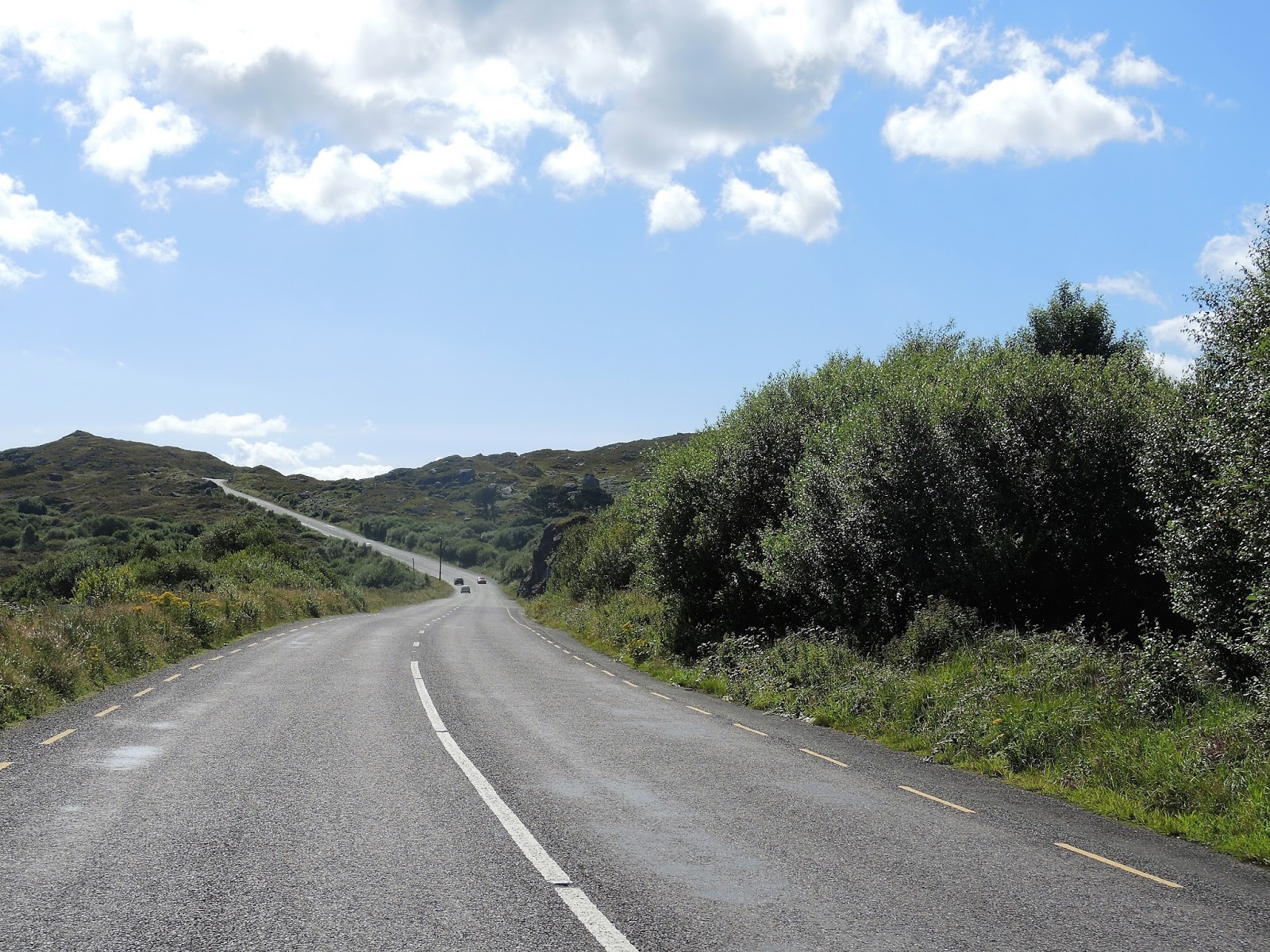
When we picked up the BMW from Celtic Rider, Paul reminded everyone to always "look right and stay left" as we learned to ride on the 'opposite' side of the road. Today Mike kept that in mind, as he also dealt with sweepers and 'bends', or as we would call them 'twisties' riding up, over, and through mountain ranges in southwestern Ireland on the Wild Atlantic Way that winds up the southwestern coast of Ireland.

Wayne and Colleen on the Healy Mountain Pass

Then there were the sheep - hundreds of sheep on the hillsides, high up the sheer rock walls of the mountains, and often standing in the middle of the road or voraciously eating leaves.


At one point earlier in the day, all traffic came to a halt as a family herded their cows across the narrow lane. Toward the end of our ride, a black mountain goat calmly sauntered across the road, again stopping traffic in both directions. He lives there, we're visitors, and he's obviously in charge.

Our day started with brilliant blue skies and sunshine, a comparative rarity in cloudy and rainy Ireland. We waved good-bye to Grianne, our host at the Desmond House in Kinsale after enjoying a stupendous breakfast prepared by herself and her husband, Paddy. 


Our first stop was Charles Fort, just outside Kinsale. Completed in 1682, it was built on the site of an earlier fort. The star-shaped fort is designed to repel cannon attack, and it occupies a high point on the harbor to defend the town from the sea.


Our route today took us on normal-size 2-lane highways, narrow 2-lane roadways, even more narrow side roads, and every now and then a lane with grass growing down the middle - my very favorite Irish road.


Along the route we stopped at the Dromberg Stone Circle, a circle of 7 standing stones with an urn burial in the center, established between 153 and 127 AD.


We stopped in Glandore, a small town in County Cork on the ocean, where we sat outside to enjoy our lunch and watched children in the sailing school take an ice cream break.


After lunch we rode through Baltimore, a harbor town raided by pirates in 1631 who sold the townspeople into slavery. The town plays up this history in a variety of ways, including a 'pirate' climbing the church wall.


We kept heading north into the Beara Peninsula, one of 5 peninsulas in this part of Ireland. We rode on narrow lanes with hedgerows so close to the side of the road that at times my knees were brushing the bushes on my left.


Then it was up and over the Healy Pass through the Caha Mountains, where we first encountered the sheep.


We continued on N71 into Kenmare, the start of the Ring of Kerry on the Iveragh Peninsula. N71 on this stretch goes through Moll's Gap with views of Ireland's highest mountain range, the Macgillycuddy's Reeks, the Black Valley, and lakes around Killarney, our stop for the next 2 nights.


We rode 150 miles over 7 hours through some of the most beautiful country and fun motorcycle roads we've ever been on. Tomorrow we complete the Ring of Kerry, riding along the Atlantic coast. 

Wednesday, August 9, 2017

Rain, castles, and more rain in Ireland on a BMW motorcycle

"It's a lovely, fresh rain" said our waiter last night, as the rain poured outside the open glass window of the pub. With that phrase in mind, we pulled on rain gear in the morning before we left Kilkenny, and made good use of the raingear as it rained off and on throughout the day.

We parked our motorcycles outside Cahir Castle, admiring the ducks in the river outside the castle walls as the rain came down hard.


Built in the 13th century as a defensive castle, it was purchased in 1375 by the Butler family, who owned much of this area of Ireland, including several other castles. Because the family surrendered to Cromwell in 1650, the castle was spared destruction and was remodeled and renovated several times over the years.


Some of the rooms inside the castle have been recreated as they might have appeared around 1600. The banquet hall features an impressive set of antlers high on the wall.

We ate lunch in the Shamrock Lounge just down the street from the castle, because how could you go wrong eating in a place called the Shamrock Lounge? The food didn't disappoint, and we had a friendly chat with our waitress and the owner.


As you can tell from the photo, it started to rain again as we finished lunch, making it difficult to take pictures of the countryside as we rode along on narrow paved roads with hedgerows so close I could reach out and touch them - if I wasn't worried about thorns.


The rain held off as we pulled into the parking lot of Blarney Castle, home of the famous Blarney Stone.


A wooden structure was built on this site in the 10th century, followed by around 1200 with a stone structure. The current castle was built in 1446 on the foundations of the stone structure. We walked through gardens of brilliantly-colored flowers on our way to the castle.


The guidebook wasn't exaggerating about the steep, narrow, and slippery winding stone staircases necessary to climb up to the top of the castle to reach the Blarney Stone. It didn't help that a misting rain was falling, making the stones even more slippery. The climb, however, was worth it.


We continued our ride south to the town of Kinsale, located on the southwest coast in County Cork, and the official start of Ireland's Wild Atlantic Way that we'll be traveling for the next 2 days. We're hoping for less rain!

Monday, August 7, 2017

Ireland Day of the 1000 Bends


We planned our trip for months, and today we started the first day of our 5-day Ireland motorcycle tour with Celtic Rider. Mike and I toured with Paul and Liam 5 years ago, and it was lovely to see them again and visit the shop, right next-door to Paul's 492-year old home.


After a safety orientation and packing up the bikes, 5 of us followed Paul for a shake-down ride:  Wayne, Colleen, Maureen - a rider from Canada - and us. Everyone kept reminding themselves to "look right and stay left", and after about an hour felt more comfortable going through roundabouts 'the wrong way' and navigating narrow Irish lanes.


Even though I wore my raingear, I never needed it because even though the skies were dark and we felt a few random raindrops, it never really rained. We rode through 4 counties in the province of Leinster:   Kildare, Wicklow, Carlow and Kilkenny, passing bored-looking cows, sheep and goats enjoying the abundant grass, a couple of horses looking over a stone fence, and beautifully-kept houses surrounded by trim fields. Paul calls this first day of the trip the "Day of the 1000 bends" because there is rarely a straight stretch of road as we wound our way around the countryside.


We pulled over to the side of the road across the river from Baltinglass Abbey so Paul could make sure each rider was comfortable with their bike.


The Abbey was founded in 1148 by Cistercian monks and was one of the richest abbeys in the 1600's until Henry VIII ran into marital trouble, left the Catholic church, and founded the Church of England.


Paul explained that local children learn to canoe in the River Slaney, and in fact that all Irish children learn to swim because they live on an island covered in numerous lakes, rivers and streams.

We continued winding our way around the countryside, stopping for a late lunch at The Forge restaurant in Tullow, County Carlow.


The restaurant is housed in a 120-year old granite building that once was the home of a forge. We sat outside enjoying the day and the fabulous food - carrot and root vegetable soup, delicious brown Irish bread and butter, and ham, cheese and tomato toasties. Paul kept us laughing with stories about his motorcycle adventures and local history.

Paul stayed with us for a few more miles, then pointed us toward Kilkenny and turned off toward home. We rode on winding narrow roads through more bright green fields and small towns with stone houses, and finally into Kilkenny, our stop for the evening.


We're staying at the River Court Hotel on the bank of the Nore River, across the river from Kilkenny Castle. After checking into our rooms we walked across the stone bridge over the river to the castle, with 1 hour before closing time to take a tour of the castle.


Originally the Anglo-Norman stone castle was built during the early 1200's, and over the centuries it was remodeled by the Butler family who purchased the castle in 1391. The family owned the castle until 1967 when they sold it to the town of Kilkenny for a token payment.


The Office of Public Works undertook a massive renovation and rebuilding, and today we were able to walk around the inside of the castle decorated as it would have looked during Victorian times.


Kilkenny, or in Irish Cill Chainnigh, meaning "church of Cainnech" was founded in the early 6th century by St. Canice, and later became a thriving market town surrounded by tall stone walls. The winding narrow streets, colorful old stone houses, and parts of the original wall attract tourists, artists, and craftspeople. Since today is a Bank holiday, the streets were full of people on holiday. We walked across the street from the hotel to Matt the Miller's for dinner and a pint, enjoying the traditional Irish music and friendly waitstaff who traded jokes and information about life in Ireland vs the US.

We managed to avoid the rain all day until we parked the BMWs, and dashed in and out of the rain on our way home from the castle and again later on our way back from dinner. We're all looking forward to a full day on the motorcycle tomorrow, heading south to the seaside town of Kinsale.

We're loving our time in Ireland and thank Paul for a brilliant first day.


Sunday, August 6, 2017

2 days in Dublin: water, barley and yeast

After a very long day - and overnight flight - we arrived in Dublin, Ireland on Saturday morning. Mike and I were here 5 years ago (check out our blog from 2012!) and this time we're meeting Mike's brother Wayne and his wife Colleen for a 2-week adventure that includes time in Dublin, a 5-day motorcycle trip, and 4 days' hiking.

We hit the ground running, trying to convince ourselves that we weren't sleep-deprived, with our first stop in Temple Bar for lunch and Irish beer. Fortified, we set off off on the Hop-on Hop-off Bus Tour, dodging the rain as we went.

Next up was the Christ Church Cathedral, founded around 1030 AD by the Vikings. It has a long history of renovations, additions, rebuilding, and switching religions based on the whims of whoever conquered Ireland.


I love wandering through old churches, admiring the intricate craftsmanship and decorations, the gorgeous stained glass windows that even on a cloudy and rainy day radiated sunlight, and thinking about the millions of people who have walked these floors over hundreds of years.


Dublin's winding cobblestone streets make walking around the old part of the city a lot of fun. We ran out of the rain into the Dublin Castle, built in the 1200's and rebuilt several times over the centuries as it changed functions from a Norman castle, to a military fortress, prison, and seat of English administration.


We continued on the bus, enjoying the drivers' commentary and stories about the buildings we passed. After a short nap, we finished the evening with dinner at Lott's Cafe Bar and live music at The Merchant's Arch, a building dating from 1821 just across the Ha'penny Bridge from our hotel.

After a very welcome sleep in a real bed instead of trying to scrunch up and sleep in an airplane seat, we started Sunday by walking to the Guinness Storehouse tour.


Our self-guided tour started at 9:45am, which may seem a wee bit early to sample Guinness, but by the time we wandered through 5 floors of Guinness history and brewmaking demonstrations, we were ready to sample a pint in the Gravity Bar,  a round, glass enclosed space 7 stories above Dublin.


Arthur Guinness signed a 9,000 year lease in 1759 when he started brewing beer in this same spot in Dublin, and over the years the brewery grew from 5 acres to 62 acres in the heart of Dublin. We learned how water, barley, yeast - and one additional ingredient, hops - are combined to make Guinness.

We climbed down the stairs at Guinness back to ground level, and rode the Hop-on, Hop-off bus around Dublin, sitting on the top deck of the greendouble-decker bus whenever it wasn't raining. Our next stop was a tour of the Teeling Distillery, where descendants of the original Teeling family are once again distilling whiskey in Dublin.


Once again, we learned that water, barley and yeast are combined to produce whiskey. Teeling whiskey, like all Irish whiskey, is triple-distilled to make it extra smooth, and then aged for at least 6 years to develop the unique flavors.


To continue with the theme of sampling Dublin's alcohol history, we stopped for a very late lunch at Ryan's Bar to celebrate the return of the Ryan brothers to Ireland.


After a very welcome early evening nap, we enjoyed dinner in the Temple Bar area, choosing to make this an early evening so we can pack and get ready for our motorcycle trip that starts tomorrow. Instead of walking or riding a bus, we'll be on BMW motorcycles, wandering around Ireland. Stay tuned!